
Practicing mental calculation benefits you in everyday life as it sharpens your intellect and improves your understanding of numbers.
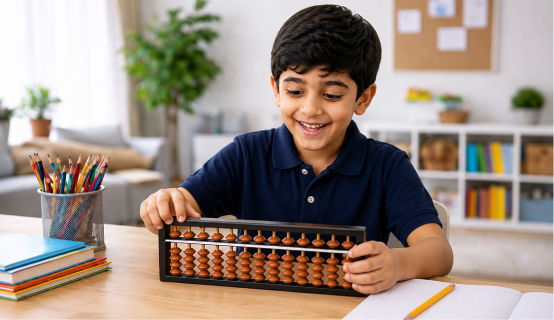
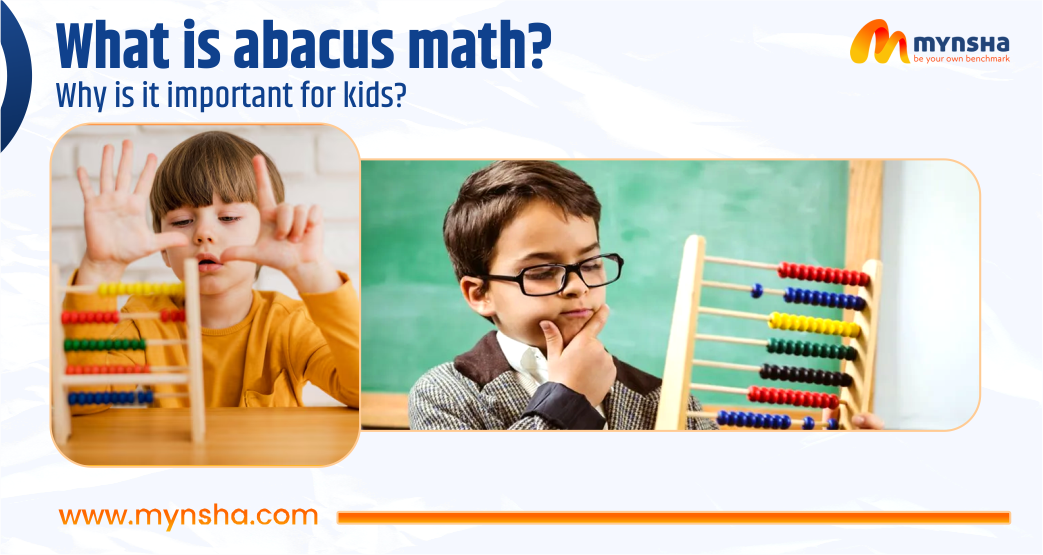
Abacus mental math is a unique technique used to develop these skills through visualization and step-by-step thinking. It contributes to improving a learner’s ability to focus on multiplication problems and solve them more quickly.
In this blog, we will share how learning on an abacus helps your child’s brain and makes mental calculations more enjoyable.
How Abacus Enhances Mental Calculation
Visualisation Technique
While training with an abacus, students focus on how beads are moved, which helps them improve their math problem solving skills. Trying the abacus and mental math increases your focus as well as your ability to remember many details. A report in Frontiers in Psychology suggests that training using the abacus can greatly improve both working memory and the ability to understand numbers. (Source: Frontiers in Neuroscience)
Structured Thinking helps in solving issues.
Using the abacus practically teaches people how to tackle problems step by step. When using the abacus mental math technique, students learn to think logically and analyze things better. According to research in the International Journal of Academic Research in Progressive Education and Development, those who practiced abacus mental arithmetic saw an improvement in their skills to solve mixed math calculations. (Source: ResearchGate)
Therefore, adding abacus lessons to the coursework may play a key role in developing students’ math skills, mental features and academic achievements.
Cognitive and Academic Benefits of Abacus Mental Calculation
Practicing abacus mental math is more than just a way to improve speed in calculations—it’s a powerful tool for enhancing overall cognitive development. Learning with the abacus makes students better at numbers as well as more focused, concentrated and with improved memory.
One of the key benefits is stronger pattern recognition. Regularly exploring the placement of beads encourages learners to notice patterns of numbers easily. With this skill, concepts such as multiplication tables, factors and equations feel clearer and simpler to deal with.
The repetitive yet rhythmic nature of the abacus and mental arithmetic also helps reduce math anxiety. Traditional ways of learning can make some students experience stress or find it very difficult. Using an abacus makes learning hands-on and increases a student’s confidence. Getting each question right inspires the learner to continue and feel proud of their progress with each study period.
Teachers have observed that students engaged in abacus and mental math perform better not only in regular math lessons but also in reasoning-based sections of competitive exams. Math students can easily deal with complex questions because they can picture numbers and break the process down into smaller steps.
Furthermore, using an abacus helps students concentrate more during their education. As their memory improves, they start sharing more in class and feel more confident about their schoolwork. Such mental exercises benefit figuring things out in maths and many other disciplines.
In essence, abacus mental math fosters a growth mindset, preparing learners for academic excellence and lifelong problem-solving. The abacus can play a key role in improving students’ skills or making lessons more effective for teachers.
Tips to Improve Mental Math Using Abacus
Becoming better at mental arithmetic can be achieved by practicing often, not by spending all day studying. Whether you’re just starting your abacus mental math journey or looking to improve your skills, the following strategies can help students, teachers, and parents build a more effective learning routine.
1. Start with the fundamentals
Begin by using an abacus to perform simple arithmetic actions such as addition and subtraction. It is important to learn this first to notice how beads behave, where you move them and what each part represents. As soon as the easy ideas are understood, students can easily try more advanced tasks such as multiplication and division.
2. Increase the amount of work as you play
Let the process develop gradually. Whenever the students are ready, help them try mixed addition, subtraction, multiplication and division with two-digit numbers. This approach encourages mastery at each level before moving forward and supports long-term learning of abacus and mental arithmetic.
3. Make learning a daily habit
Reserve at least 15-20 minutes every day for focused practice. Studying a little bit often is more productive than studying for long periods in one stretch. When you solve problems regularly, your mind gets stronger, visualizing beads becomes easier, and you calculate faster.
4. Make use of digital tools
In today’s digital-first world, students can access several online platforms and apps designed to support abacus mental math. They provide organized lessons, quizzes that catch your attention and colorful images to help you understand the subject. They support students by providing instant feedback and showing where they have improved or made errors.
5. Apply the Lessons to the Challenges You Face
Encourage learners to use mental math during everyday tasks. Examples include:
- Total up the expenses as you go around the grocery store.
- Find out how much of a discount you receive when you purchase.
- Alter unit measurements when cooking.
- Get information on the time or organize daily activities.
These real-world applications not only reinforce classroom learning but also show students the practical value of abacus and mental math beyond textbooks.
Conclusion
The abacus is more than a counting tool—it’s a time-tested method for building strong mental math skills and developing a sharp, confident mind.
In regular practice, students gain the ability to stay concentrated, improve their skills and use logic in their studies and daily routines.
To get help in math early, students can include learning on an abacus in their daily activities.
You can begin with Mynsha’s expert-guided, interactive programs. Their online platform makes abacus mental math accessible, engaging, and effective—right from the comfort of your home or classroom.